
















- Articles
- The Virtualization of Work: Why Agentic-AI is the Cloud Moment for Business Operations
The Virtualization of Work: Why Agentic-AI is the Cloud Moment for Business Operations

There is a moment in every major technology innovation when the conversation steps up, and you realize that this is bigger than what anyone ever imagined. It stops being about the technology itself and starts being about the massive disruptive shift that this technology will make possible. This is not new – for instance, we reached that moment with cloud computing roughly a decade ago. We are reaching it again now with Agentic-AI, and the leaders who recognize it early will define the next era of enterprise back-office operations.
But to understand why, you need to stop thinking about Agentic-AI as an automation story. It is not! It is a virtualization story. It is about the “Virtualization of Work”. To see why that distinction matters, it helps to go back to what Cloud Computing (the original story of virtualizing everything!) did, and think about the tsunami that it triggered.
What Cloud Actually Taught Us
When Cloud Computing emerged, the dominant debate and concerns were about trust and security, and about responsiveness and performance. CIOs questioned security, doubted performance, and hedged with hybrid architectures, keeping one foot on-premise (just in case!) while cautiously venturing into the Cloud. It felt prudent at the time.
What that debate missed entirely was the structural shift beneath the surface. Cloud did not simply relocate servers and storage. It made the physical server conceptually irrelevant, and went further and made anything physical irrelevant. A production environment that once required months of hardware procurement, datacenter capacity planning, and technology refresh cycle management, could now be instantiated in minutes through a few clicks on a computer, applications were no longer chained to specific machines or operating environments. Entire technology estates became fluid, configurable, and scalable on demand. And as expected, the roles associated with on-prem technology either became redundant or morphed into something more sophisticated. Mundane repetitive activity disappeared
The real breakthrough was not cost reduction. It was the elimination of constraints that had shaped how IT organizations were built and run for decades. Capacity planning, procurement lead times, geographic dependencies, and hardware lifecycle management all became largely irrelevant. CIOs who understood this did not just move workloads to the cloud. They restructured how their organizations operated around the absence of those constraints.
But even that turned out to be just the tip of the proverbial iceberg, because it actually reshaped the entire architecture of value delivery through technology. It enabled collaboration (both inside and outside an organization) at a scale that was not even previously imaginable. The success of mobile technology would not be possible without the Cloud, which made everything device-agnostic (another constraint that fell by the wayside) – in fact, devices were just a window, everything happened on the Cloud, invisible, but essential!

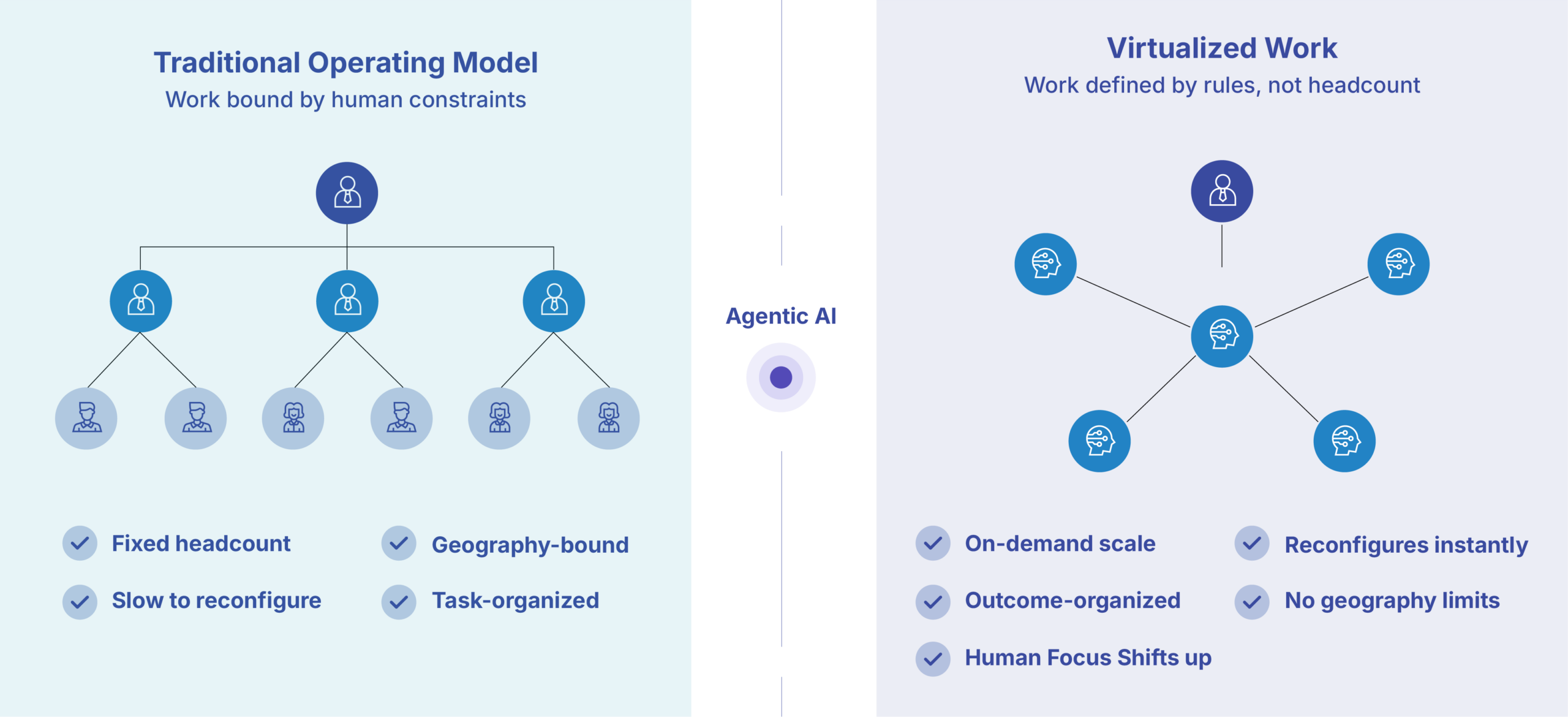
Work has always been bound by physical and organizational constraints i.e. the people available to do it, where those people are located, how they are organized, who they report to, the role they played, how many of them are needed. Every operating model decision, every shared services strategy, every workforce design has been an attempt to optimize within those constraints.
Agentic AI removes the constraints themselves. When agents execute processes, the work is no longer tied to headcount, geography, or organizational hierarchy. You define the rules, boundaries, and outcomes virtually. The agents operate within them. Want to redesign a process? Reconfigure it. Want to test a new operating model? Run it in parallel. The changes are immediate, testable, and reversible in ways that human-dependent models never could be.
This is not incremental efficiency. It is a fundamental change in the unit of organizational design. Just as cloud did not merely reduce the cost of servers but eliminated the need to think about servers at all, Agentic AI does not merely reduce the cost of certain tasks. It eliminates the need to organize people around those tasks – and will allow your current people to focus on higher value tasks and on constant innovation. And furthermore, you can deploy your innovations iteratively, and realize the benefits at speed. Fail fast but continue moving forward – think of this as Agile Transformation!
The Strategic Implication Leaders Cannot Afford to Miss
Cloud took a decade to become non-negotiable. Agentic AI will not have that luxury of time. The pace of capability development, the depth of enterprise integration already underway, and the competitive pressure building across every sector are compressing that timeline significantly. The inflection point is closer than most organizations think.
The right question for senior leaders today is not whether to adopt Agentic AI. That decision is already being made by market forces. The right question to ask is whether your organization is thinking about it at the right level. Are you asking how to automate existing processes? Or are you asking which constraints in your current operating model only exist because humans have to do the work?
Those are very different questions. And the second one is where the real strategic opportunity lives.
The Virtualization of work is not a feature of Agentic AI. It is the point of it. The leaders who internalize that distinction now will not just operate more efficiently. They will build organizations that are structurally different, more adaptive, and significantly harder to compete against.
About Chazey Partners
Chazey Partners is a global management consulting firm specializing in operations transformation and shared services. As Agentic AI reshapes how organizations think about work, we bring deep expertise in back-office operations and operating model design to help leaders ask the right questions, and act on the answers. Whether you are at the beginning of your Agentic AI journey or looking to accelerate an initiative already underway, Chazey Partners brings the frameworks, the experience, and the objectivity to ensure you are thinking about it at the right level. To learn more, visit www.chazeypartners.com.
Author

Shaji Farooq
CEO, Chazey Partners


Don't forget to share this post!